• A review of the “My Stealthy Freedom” social movement in Iran

    Three years ago, while I was browsing through Facebook, a suggested page appeared on my timeline called “My Stealthy Freedom آزادی یواشکی زنان در ایران”.  My Stealthy Freedom (MySF) is a feminist activist page where women protest against Iran’s compulsory veiling (hijab) law by posting photos of themselves removing their headscarves in public.  Some photos focus on women sans-hijab, but others focus on the public’s reactions around them.  While feminist media is not a new development in Iran, the use of the internet for social activism and cyberfeminism is relatively contemporary.  The internet community is no longer bound by space and mobility limitations, and as such, the My Stealthy Freedom campaign was able to amass and global following.   

    MySF is a cyberfeminist campaign created by well-known Iranian journalist Masih Alinejad.  Although she is an Iranian citizen by nationality, Alinejad was exiled from Iran for activist activity and was living in the United States when she launched the “My Stealthy Freedom” Facebook page.  To gain a comprehensive understanding of MySF as a digital social movement this paper will explore the significance of Iran’s feminist history, how social media fits into that feminist discourse, and how MySF contributes to it.   

    A Brief History of Iran’s Feminist Media 

    Iran’s history of feminism follows its history of governance and religious control.  Iran has not always held strict policies on governing women and their bodies.  In fact, in the early Sassanid dynasty, before 651 A.D., Iran had been ruled by two princesses, Pourandokht and Azarmidokht, respectively (Shojaee 2016, pp.2).  After 651 A.D., Iran was conquered and controlled under Arabian rule.  With this transition of political power also came the spread of Islam through that region of the Middle East.  The small equalities women enjoyed in Iran’s past were now withdrawn as women suffered greater oppression under Islamic law.  This new ruling age lasted over a century from 1795–1925.  Women were not the only population affected by these changing political and religious climates. The whole country’s ideology shifted with the Iranian Constitutional Revolution of 1905, an event that many scholars consider to be “a turning point in the history of modern Iran” (Shojaee 2016, pp.2).  With this new constitutional structure the people of Iran aspired to reset order through secularism, representative government, and the decrease of religious conservatism.  

    The use of cyberfeminism, a term first used by Sadie Plant in 1994 to describe the use of the internet, cyberspace, and new-media technologies during the “third-wave” of feminism (Conslavo 2012) has contributed to the evolution and expansion of MySF.  Utilizing the internet as a medium for feminist movements gives a number of advantages to groups subjected to legal scrutiny, such as women in the Middle East.  Cyberfeminism offers for a sense of anonymity without a defined hierarchical structure, “[A] being without a head” (Shojaee 2016, pp.13).   

    This anonymity is a crucial element to MySF’s longevity of activism.  Feminist social movements are not new to Iranian culture.  Access to the internet did not suddenly give Iranian  

    women a medium to voice their opinions.  Earlier generations have been doing that through other resources available to them during their lifetime.  One of the most prevalent forms of circulation being newsletters and magazines.  While circulating publications was a good way for women to have their voices heard by other women and create a sense of solidarity among the like-minded.  Publishing enterprises were too easy to be traced back to the source and forced into closure by Iranian morality officials of authority.  Shojaee offers the following historical case studies of women-centered publications in Iran. 

    In 1911 the first by women for women publication in Iran was launched.  Danesh, created by Dr. Kahal, she described as a “magazine for the discussion of family issues, teaching housekeeping, feminine wifely duties, and child-bearing” (Shojaee 2016, pp. 4).  Although the topics covered conformed with traditional views of womanhood, family, and motherhood, it still offered an outlet for women to voice their ideas, concerns, and beliefs.  While traditional in nature, this publication was revolutionary in practice as it paved the way for future female-centered publications.  In 1913 Maryam Amid Mozayenossaltaneh began publishing a journal entitled Shokonfeh.  With its focus on women’s education and literacy it entered a realm of sharing knowledge that had never been available to the everyday woman of Iran before.  Some topics covered by this journal included teaching child-rearing and housekeeping practices, promotion of ethical standards, combatting superstitious beliefs, and familiarizing women with different genres of literature (Shojaee 2016, pp.4).  What made this publication so revolutionary for the time was it openly criticized societal practices such as child marriage and gained the attention of international audiences as well. 

    After introducing Iranian women to female-centered publications the path was laid for activists to begin speaking their truth and having their voices heard by women outside their immediate proximity.  Word-of-mouth activism has its place in feminist history, but its limitations impede continuous growth and accomplishments.  The first publication to identify itself as political and include commentary that critiques Iran’s status quo was Women’s Tongue, officially licensed and published by Sedigheh Dolatabadi (Shojaee 2016, pp.5).  After publishing articles criticizing certain aspects of Islamic culture, such as the requirement for women to wear head coverings like the hijab, she received death threats.  The journal was only in publication for  

    barely over a year before it was shut down following a series of editorials criticizing the British influence and colonialization of Iran.  Even though the journal was short-lived, its impact reached far beyond its tenure planting the seeds of activism throughout the country’s female population.   

    The fight against compulsory veiling did not end with the discontinuance of Women’s Tongue journal.  These early publications helped create solidarity among progressive Iranian women, which in turn forms a foundation for feminist activism to flourish.  MySF’s contribution to strengthening this solidarity will be discussed later.  Upon Dolatabadi’s death she requested that no women wearing hijab were allowed to participate in her funeral or grave side services.  Her revolutionary thinking, in life and death, has made her a figurehead for feminism in Iran.  Her legacy was further established when her grave was defiled by Islamic extremist clergymen.  This act meant to disgrace her memory only succeeding in unifying more Iranian women in feminist movements.  In 2003 the first professional NGO women’s library was established in Tehran under her name.  Simin Behbahani, an Iranian woman poet and author was one of the  

    founding members of the library.  After the establishment of the library, a book prize named after Behbahani was awarded every year for the best book published in the field of women’s studies (Shojaee 2016, pp.6).  In 2012 the women’s library was closed by religious security forces.  The book prize continues to be awarded every year despite threats of violence; nominees, award winners, and news are announced through internet channels.  One of the first examples of Iranian women utilizing the internet to continue activism efforts in spite of harassment and intimidation.   

    Backlash Against Feminist Social Movements 

    Early examples of women’s publications tackled a number of different subjects, from a woman’s role in the home and society to advancements in education and literacy efforts.  Compulsory veiling laws and anti-hijab movements were touched on, but it wasn’t until 1921 when Shahnaz Azad’s Nameh Banovan (Ladies’ Letter) took up the fight against headscarf laws head on.  With her magazine’s motto proudly placed on the cover, “The awakening and salvation of helpless, long-suffering women” (Shojaee 2016, pp.6) the publication was only in circulation for three days before the Iranian government intervened and ceased its printing production.  Iran’s changing political climate has impacted women’s social movements just as much as the press and other media outlets.   

    In 1942 Iran was pushed in political uncertainty and disorder when leader Reza Shah Pahlavi (who was responsible for the discontinuance of the Ladies’ Letter publication) was pushed out of the country following the Second World War.  His successor, Mohammad Reza Shah, instituted a less controlled regime allowing a variety of human rights such as freedom of speech and the right to assemble.  This more open political climate not based on rigorous Islamic standards allowed for feminist activist groups to thrive within Iran.  Some historical scholars have argued that it was not the government’s goal to allow for greater female independence, but that the government’s priorities were simply placed elsewhere, such as expanding the national oil industry, that these human rights were a byproduct of the shift in focus.  Another women’s publication entitled Women’s Awakening was started by the Tashkilat-e-zanan Iran (Iranian Women’s Party Organization), (Shojaee 2016, pp.7).  The main topics covered in Women’s Awakening included putting an end to factory exploitation of women workers and the need for gender pay equality.   

    Unfortunately, during this time period liberation attempts for women were short lived.  Iran’s government was once again turned upside-down in 1953 when its government collapsed.  Part of restructuring effort following the United States’ Central Intelligence interference including placing more strict regulations on the freedoms previously allowed, such as freedom of speech.  Media outlets and the press within Iran was once again under government scrutiny and control.  The focus was not specifically on feminist activism and liberation efforts.  Women organizations were still allowed to publish freely, as long as their material did not criticize the government.  The press regulations were not anti-feminism, simply anti-government criticism.  Realistically, these regulations still greatly impacted what feminist groups could and could not circulate to the public.  As women became more and more opposed to following Islamic head covering requirements, this topic was often in the forefront of feminist social movements.  The problem was that as they voiced their discontent for head coverings, they would also be voicing criticisms against Iran’s government for following Islamic customs.  Women’s publications were free to be circulated as long as they played by the regime’s rules.   

    Iran once again became a dictatorship in 1963 under Mohammad Reza Pahlavi when he  

    named himself Shah (King) and proposed his national referendum known as the “White Revolution” or the “Revolution of the Shah and His People” (Shojaee 2016, pp.8).  ­Women gained a few new rights under this reform, such as the right to vote.  Although many might believe this to be a great victory for women’s social movements in Iran, some feminist groups actually disregarded the reform as hypocritical because women were given these rights by a male dictator; they were not earned by women.  During the Shah’s reign, until he was overthrown in 1979, there were little advances made by feminist groups.  Fewer social movements were  

    established and even fewer women’s publications were circulated.  Women were essentially omitted from Iran’s media in general, including newspapers, books, magazines, TV broadcasts, and news outlets.  The government was under stricter regulation in a dictatorship, and in turn the public was more strictly controlled by the government.   

    Whatever rights women had gained in the previous regime were quickly reversed in 1979 with the Iranian Revolution, even though they were promised the opposite by the Islamic Revolutionary groups.  One week after these groups seized power, they abolished the current system of family law, legalized the practice of polygamy under Islam, and announced that all women of Iran (Muslim or not) must wear hijab under legal order.  A fight that had been mostly taken up by Islamic feminist groups was now shared by non-Islamic women as well.  Following these announcements, thousands of Muslim and non-Muslim women came together in protest on International Women’s Day (March 8, 1979).  Despite their efforts the proclamations were instituted into law a short six months later.  Many social movement demonstrations were attempted following the Islamic Revolution by a variety of groups, not just women’s organizations, but even “small signs of resistance were repressed by the sharp sword of the Islamic Revolution” (Shojaee 2016, pp.10).   

    These struggles soon shifted from social activist groups versus the government to social activist groups versus the pro-government population.  Feminist organizations were not only receiving backlash from the government and religious groups, they were also being targeted by conservative Muslim women who believed compulsory hijab was an issue of morality, not just law.  Feminist publications during this time included opinion editorials which encouraged anti-hijab readers to confront pro-hijab women in defiance.  Women’s publications in the past had  

    focused on bringing women together in solidarity over shared interests; now we are seeing a stage set for women to oppose each other instead.  Changes in the Iranian government did more than set boundaries and laws to control female citizens, it created a divide between them.  This divide worked in the government’s favor because it showed there were women in Iran who supported strict religious legislation and created peer pressure among other women to conform.  The social divides between conservative religious and secular pro-feminist women are still happening now.   

    From Cyberfeminism to Social Media Activism 

    One of the main limitations women’s publications in Iran experienced was the inability to reach a wide audience.  Only so many issues could be published and they only reached the hands of a relatively small number of women.  These women were usually like-minded and the issues being challenged were not reaching desired audiences.  As mentioned in earlier sections, the introduction of the internet opened up a new sphere of communication for feminists in Iran to create solidarity and reach out beyond their immediate spheres of influence.  The government censorship most types of publications are subject to do not always have influence over internet-based media.  Unlike the feminist media of Iran’s past, articles and editorials released on the world wide web are more difficult to identify and take down by government officials.  It is also difficult for the source person or organization to be identified and targeted, making cyberfeminism and social media activism safer alternatives than other platforms of resistance.  The cost associated with social media activism is also an advantage for populations that are in a struggling economy.  The magazines and women’s journals in the 20th century were expensive to publish which limited the amount that could be produced and circulated.  While there are some costs associated with feminist organizations to create webpages, creating social media accounts are free and accessible to anyone.  

    Social movements are defined as “networks of informal interactions between a plurality of individuals, groups, and/or organizations…on the basis of shared collective identities” (Diani 1992).  The internet allows for a virtual space women can enter and feel accepted and understood on the social issues that are important to them.  Finding a like-minded online community can do wonders for building a basis of solidarity among Iranian women who feel controlled by the patriarchal society they live in.  The liberation cyberspace allows for freedom of speech cannot be overestimated, especially for women in Iran who are under tight control in their physical spaces (Gheytanchi 2001).  Some may argue that the internet is impersonal and does not offer the same strength in solidarity that a real-world meeting space would (Koo 2016, pp.145).  I argue that moving these social movements out of the real world and into virtual spaces does not take away from the development of “collective agency” (Snow 2001) or “collective effervescence” (Durkheim 2008).  These bonds are formed by a meeting of the minds, not a meeting of the body alone.  Anne Hornsby, who also references Durkheimian theory in virtual spaces, reinforces the importance of rituals and how they relate to social solidarity, “Durkheim would agree that rituals help create and sustain moral community” (Hornsby 2013, pp.87).  The MySF community has organically created its own rituals in the way members post content and others engage with that content.  The storytelling that community members engage in is the most prevalent type of ritual found on the MySF page.  A majority of the photos or videos posted will be accompanied by a story the poster wants to share as well.  These postings will then be commented on or shared by other community members who tell their own stories.  Having a safe space to share thoughts, ideas, opinions, and experiences is what creates solidarity within a social movement.  Virtual spaces are where these thoughts can be exchanged openly and with little threat of retribution from oppressors.   

    Social media activism also allows for greater engagement amongst a wide group of participants.  Different levels of participation emerge including active participation and passive engagement (Koo 2016, pp.144).  Online social movements can usually be divided into two distinct groups of participants, those who are actively posting content and communicating with other members and those who visit the virtual space and take in the content but do not provide their own input.  Social media platforms are almost tailored to support these types of engagements, active and passive.  There is a sense of security that also comes with shifting social movements to online platforms.  Iranian women do not even need to leave their homes to participate and show support to feminist organizations.  Religious, societal, and legislative restrictions are placed on women in Iran which inhibits their opportunities to join social movements and activist groups.  The backlash many feminist organizations received from the government in past decades also leads Middle Eastern women to fear group membership or participation, even if they believe in the organization’s causes.  Social media activism opens doors to new participants by breaking down these barriers and many more.   

    Social media activism allows for a sense of anonymity for organizers and members.  The Facebook page My Stealthy Freedom takes advantage of the anonymity virtual spaces offer, but that doesn’t mean every community member cannot be targeted by the Iranian government or other Muslim extremist groups.  Masih Alinejad, MySF’s founder, is Iranian by birth but she currently lives and works in the United States.  This distance from Iran allows her to open and curate a space for Iranian women to protest against and challenge compulsory hijab laws without  

    fear of government interference.  The main content posted on the MySF page is women who are still located in Iran sharing photos and videos of themselves without head coverings in public.  Some photos and videos are censored to keep women’s identities private, but not all.  These brave women who chose to post photos and videos with their face in full view could be identified and receive negative responses.  Social media activism has its advantages and disadvantages, but as the world becomes more and more dependent on technology these virtual spaces will not become obsolete for a very long time. 

    My Stealthy Freedom’s Mission and Content 

    “This page does not belong to any political group and the initiative reflects the concerns of Iranian women, who face legal and social restrictions. All of the photos and captions posted have been sent by women from all over Iran and this is a site dedicated to Iranian women inside the country who want to share their “stealthily” taken photos without the veil” (Our Story 2019). 

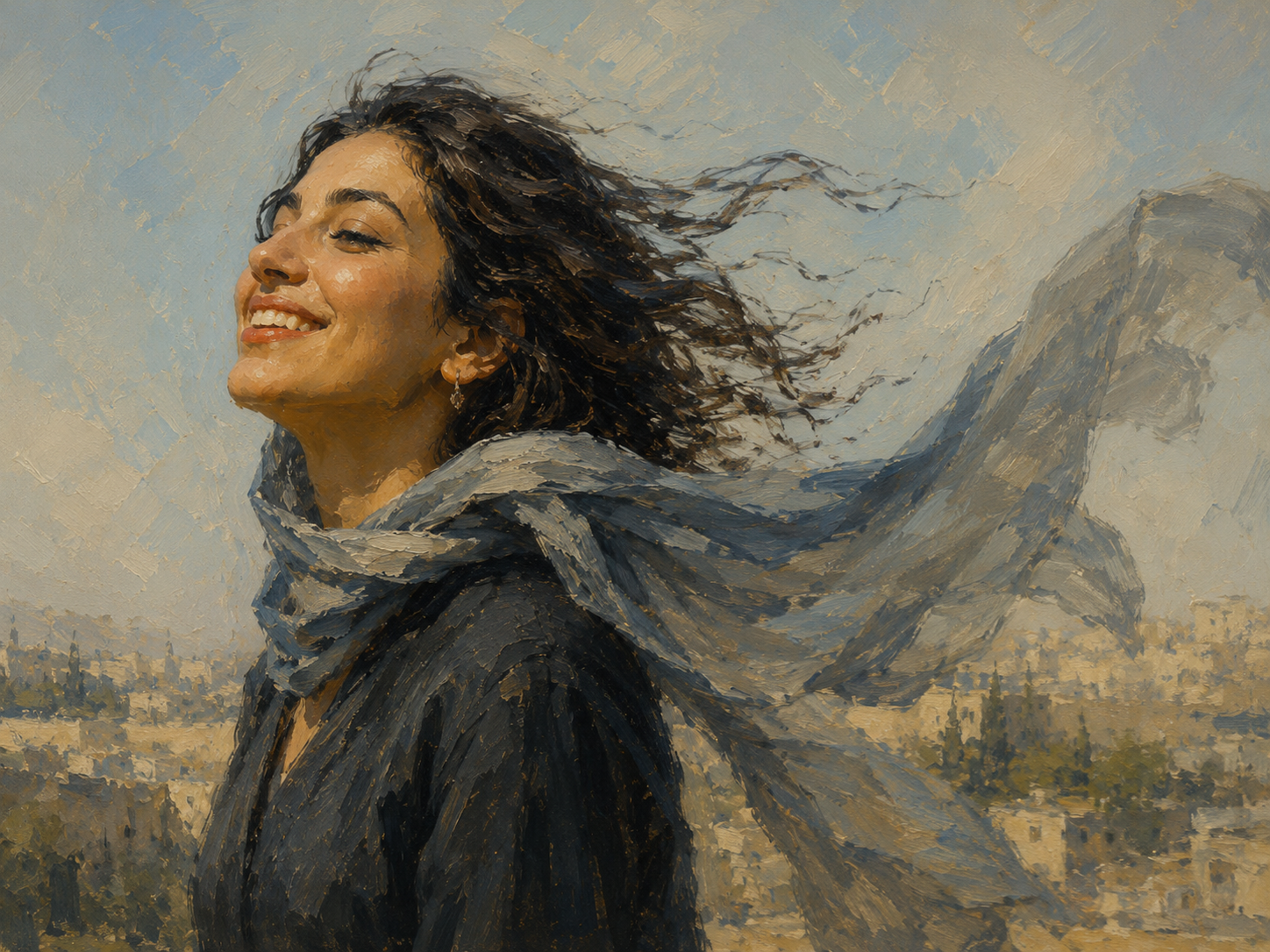
    At first glance, the women on the MySF page appear to portray an image of independence and rebellion.  These women do not look afraid to be in public without head coverings.  They even look happy and relieved to let the wind flow through their hair in the middle of the day outdoors.  Unfortunately, these first glance assumptions do not tell the true story behind the photos and videos uploaded.  “The content of the campaign’s social media is centered around the image of women as victims of an oppressive political system and of women as a conscious and dynamic opposition group against this system” (Rahbari et al. 2019, pp.9).  The description Rahbari et al. offer regarding the MySF social movement is partly true but to focus on these women as simply victims does not do them or their activism justice.  The Iranian women who participate in MySF are no longer accepting their roles as passive citizens.  While society tries to keep them in-check and conform to specific religious standards of dress and appearance, even the seemingly small act of posting a photo with their hair visible can speak volumes.  The social movement has moved past verbal communication and into recorded acts of defiance.  The women of MySF are no longer passive citizens, they are active participants in their environments and lives.  During an interview MySF’s founder explained, “I created a page called “My Stealthy Freedom”… From far away those voiceless women can express themselves for the first time in more than thirty years” (Rahbari et al. 2019, pp.10). 

    Since MySF’s creation the content has expanded from posted photos and videos to sharing news stories and editorials.  Over the past three years there have been a few postings that caught my attention.  One of which is from early 2017, an anonymous poster uploaded a video of her walking through a busy street in Iran.  In the beginning of the video she was wearing a hijab, but she soon took it off with a great flourish and continued on her journey.  Iranian officials justify compulsory hijab laws a number of ways; one of which is that non-modest women showing their hair or other body parts in public will distract and gain the unwanted attention of men.  “Even those who fail to satisfy political Islam by not conforming to the type of their scarf or the colour of their clothes can be imprisoned, fined, or sentenced to receive corporal punishment (lashes)” (Shojaee 2016, pp.22).  The video kept the woman in view, but the real focus was on the public’s reaction around her.  This choice to feature the public’s reaction is just as important as focusing on the defiant woman herself.  The mass hysteria the government believes will result from women showing their hair in public was nowhere to be found.  Men barely gave her more than a second glance, if they even looked at her at all.  Interestingly, the surrounding women took more notice of her than anyone else.  Approximately two minutes into the video the immodest woman is approached by another woman who appeared to be in her 50’s or 60’s.  This woman was wearing a headscarf that covered the entirety of her hair and a long black abaya.  Some words were exchanged in Arabic, but even without translation the context was clear through the women’s actions and demeanor.  The older woman was scolding the other for not having her hair covered.   

    Another key ingredient to MySF’s content is the ongoing communication through the comment sections under each posting.  Most people are eager to share their own stories and experiences while living in Iran.  Others praise the original posters for their bravery or just express their disdain for Iran’s political climate and Islamic centered legislation.  These comments are what builds report among community members and creates the solidarity social movements require.  In a 2018 study of collective identity construction within social media Khazraee and Novak noted, “participants clearly attempt to distinguish between ‘us’ and ‘them’… the protagonists are Iranian women facing injustice, the antagonists are religious or state authorities enforcing mandatory hijab law” (Khazraee & Novak 2018, pp. 7).  These clearly defined boundaries create a feeling of membership within a community where its members never actually meet face-to-face.  It is in the comment sections where this discourse is most evident, and we find comments such as: 

    “Thank you to the brave and ordinary individuals and families.  We support you” (“My Stealthy Freedom”, 2019). 

    “The power of those people.. mostly men.. do they not love their mums, sisters, daughters.. and protect them?  It is our hair!  Yes.. and WE decide how we want to have it.. no rule can tell us that” (“My Stealthy Freedom”, 2019). 

    “These ladies are so incredible courageous.  May they win their battle very soon – to be free.  Nobody should dictate to others what they should wear or how they should live” (“My Stealthy Freedom”, 2019). 

    Comments like those are posted by women all around the world.  Although the focus of the movement originated in Iran, its influence has been felt on a global scale.  Other feminist groups and human rights organizations have taken notice of MySF and helped spread the word to build a multi-national community.  Women’s rights are a global problem, not unique to just developing regions of the world.  MySF is an example of how women in one part of the world can be supported and encouraged by women in another part of the world.  This virtual community can meet without space or time barriers and these factors have contributed to MySF’s growth and influence.   

    My Stealthy Freedom’s Future 

    When an exiled Iranian journalist first created the MySF Facebook page I don’t think she realized how quickly the community would grow in support of her cause.  Within the first 40 days the page had received over 600,000 followers and over 500 women had uploaded videos and photos (Khazraee & Novak 2018 pp.1).  Since then, the page has continued to grow and receive international attention outside of the United States and Iran.  The page has also been referenced in news outlets all over the world.  During a 2016 interview with BBC Persian TV, Masih discussed how her campaign fits into women’s movements, “this campaign is a journalistic movement in cyber-feminism which is run by women who have become their own media subject.  If this campaign is to be connected with the women’s movement then women’s movement members should follow up” (Shojaee 2016, pp.23).  She challenges that the anti-compulsory hijab legislation movement is not just an Iranian woman problem but should be a problem for the global feminist community as a whole.   

    Although the risk of participating in an internet campaign is relatively lower risk than protesting in physical spaces, there have been reports of women who shared videos or photos on the page being arrested.  Even Masih’s family who are still living in Iran received government retribution (NIAC Staff, 2019).  During her siblings’ detainment her sister released a video compelling Masih to stop her social activism efforts due to the increased pressure her family is facing by Iranian officials.  Many human rights organizations have spoken out about the practice of targeting individuals and families, saying it is in violation of freedom of expression, a basic human right. 

    Iran’s political history is messy and unstable and as a result its citizens have become divided.  The Iranian Revolution of the 1970’s was poised to deliver greater freedoms and provide better living conditions for all Iranian citizens (not just men).  But these promises were never fulfilled and that has left some women of Iran feeling dissatisfied and actively looking for social change.  Social movements are a response to societal conditions and My Stealthy Freedom is a response to modest legislation that many women believe to be unjust and discriminatory.  Women in Iran, who are usually thought of as victims of their patriarchal culture or at the least passive citizens, have found their voices to become active players of their lives and demand environmental changes.   

    The internet has provided a new medium for social movements and the ability for people to voice their wants/needs/beliefs.  Masih took advantage of this medium and created an online community of like-minded individuals.  The solidarity that was created through a Facebook page cannot be dismissed as circumstantial.  My Stealthy Freedom’s popularity grew as more women came together over a central cause they all feel passionate about: Iran’s compulsory hijab laws.  Social media activism will not come to an end in the near future, and it is important for organizations to recognize the potential it has to further their own causes.  Millions of people can be reached with the press of a button, just as My Stealthy Freedom’s community has touched the lives of millions around the world.  

    References: 

    Consalvo, Mia. “Cyberfeminism.” Encyclopedia of New Media. Ed. Thousand Oaks, CA: SAGE, 2002. 109-10. SAGE Reference Online. Web. 4 Apr. 2012. 

    Diani, M. (1992). “The Concept of Social Movement”.  The Sociological Review, 40(1) pp. 1-25. 

    Durkheim, E. (2008). The Elementary Forms of Religious Life. Oxford: Oxford University Press. 

    Gheytanchi, E. (2001). Civil society in Iran: Politics of motherhood and the public sphere. International Sociology, 16(4), 557-576. 

    Hornsby, A. (2013). Surfing the net for community: a durkheimian analysis of electronic gatherings. In P. Kivisto Illuminating social life: Classical and contemporary theory revisited (pp. 51-94). Thousand Oaks, CA: SAGE Publications, Inc. doi: 10.4135/9781506335483.n4 

    Khazraee, E., & Novak, A. (2018). Digitally Mediated Protest: Social Media Affordances for Collective Identity Construction. Social Media Society,4(1), Social Media Society, March 2018, Vol.4(1). 

    Koo, Gi Yeon. (2016). To be myself and have my stealthy freedom: The Iranian Women’s Engagement with social media. Revista De Estudios Internacionales Mediterráneos, (21), 141-157. 

    My Stealthy Freedom. (n.d.). Retrieved November 15, 2019, from https://www.facebook.com/StealthyFreedom/

    NIAC Staff. (2019, October 9). Family Members of Iranian Activist Detained. Retrieved November 10, 2019, from https://www.niacouncil.org/family-members-iranian-activist-detained/.  

    Our Story. (2019, April 11). Retrieved November 2, 2019, from https://www.facebook.com/pg/StealthyFreedom/about

    Rahbari, L., Longman, C., Dierickx, S., & Coene, G. (2019). Transnational Solidarity with Which Muslim Women? the Case of the My Stealthy Freedom and World Hijab Day Campaigns. Politics and Gender. 

    Snow, D. A. (2001). Collective Identity and Expressive Forms. Irvine, CA: Center for the Study of Democracy. 

  • An ethnography of female Twitch streamers 

    Abstract: 

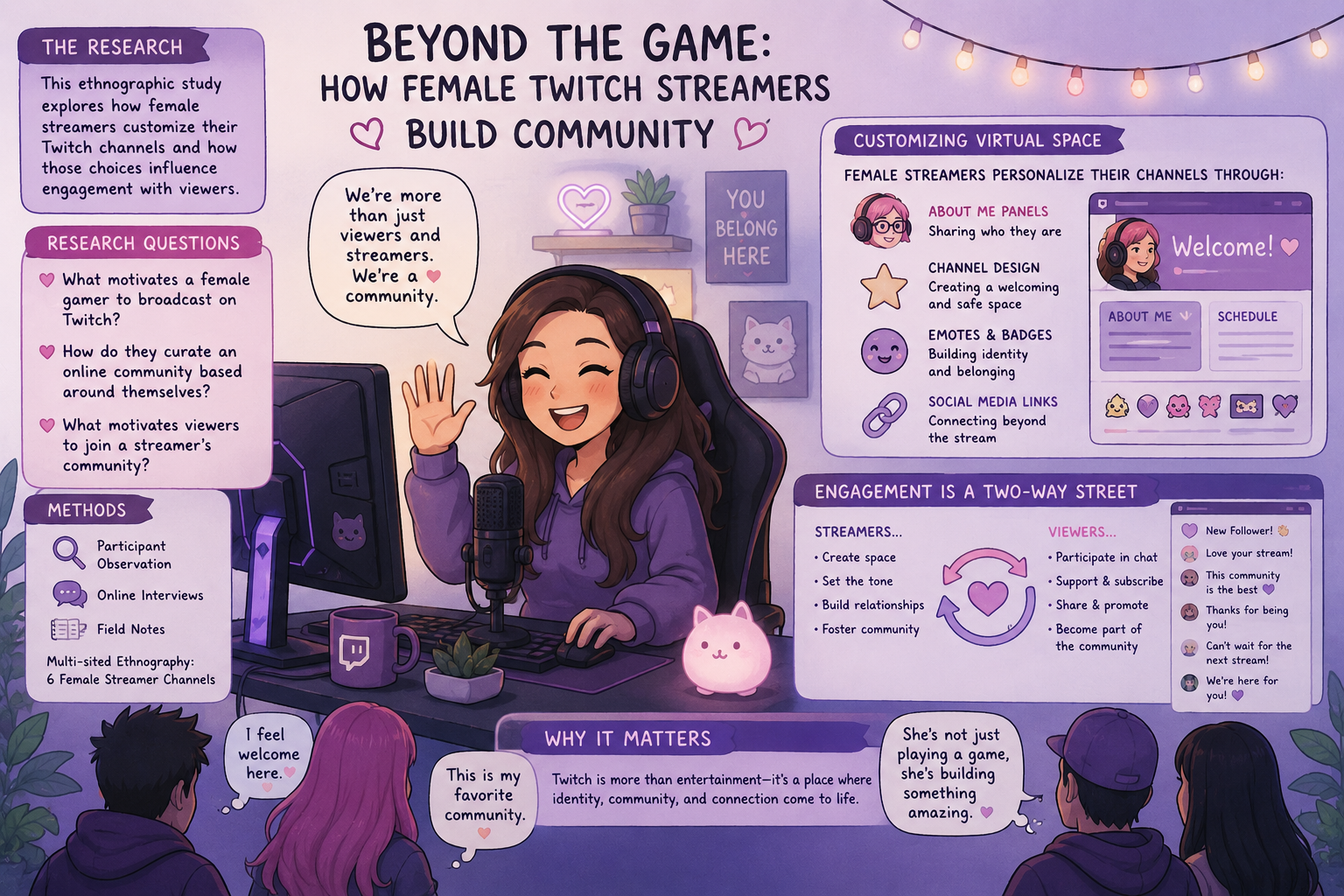
    With the introduction of the internet, social interactions have expanded past the barriers of the physical world and entered into virtual spaces.  One industry that has seen an influx of virtual space utilization is the gaming sector.  Video games are not just for players anymore; a growing trend of spectatorship has also emerged.  Viewers can watch gameplay at conventions, eSports events, and on internet streaming platforms such as YouTube and Twitch.  The purpose of this study is to gain a better understanding of how female Twitch streamers personalize their platform channels and how those choices influence streamer/viewer engagement.  This study employs qualitative methods to contribute to the growing body of work exploring how streamers and viewers engage with and influence one another through the virtual streaming platforms.  Building upon previous publications such as Hilvert-Bruce et al. (2018) and Johnson & Woodcock (2019), this study focuses on the personalized elements streamers include on their channels and how the virtual environment they have created might influence how they engage with viewers and vice versa.   

    Part 1 

    The Virtual Community 

    Welcome to Twitch. We are a global community of millions who come together each day to create their own entertainment: unique, live, unpredictable, never-to-be repeated experiences created by the magical interactions of the many. With chat built into every stream, you don’t just watch on Twitch, you’re a part of the show (About, 2019). 

    It was one o’clock in the morning when I powered up my iMac and settled into my home office chair in preparation of another video-chat interview.  I had reached out to potential informants requesting their participation for online interviews or surveys.  While I received many responses of people indicating they would be willing to complete surveys, the responses for interviews were few and far between.  As a graduate student who also works a full-time day job, 1:00 AM was a less than an ideal meeting time, but I knew if I wanted information from my informants I would need to adhere to their schedules. 

    My informant, a woman who by her appearance I guessed to be in her early to mid-twenties, answered the FaceTime call.  As our conversation progressed she seemed excited and eager to share her views on gaming culture and why she enjoys watching live streams of other people playing video games. 

    She explained, “I really think it’s more about having a community to belong to than just entertainment.  Yes, watching someone play video games can be entertaining, especially if they are really good, but I want to spend time with people who have similar interests too.  I have found those people through Twitch.tv.”  This statement in particular resonated with me and sparked the questions that would result in an observational study about female gamers and how they foster their own online communities on Twitch.  What motivates a female gamer to broadcast on Twitch?  How do they curate an online community based around themselves?  What motivates viewers to join a streamer’s community?  These are the three main inquiries I set out to find answers to1.   

    “[…] unique, live, unpredictable, never-to-be repeated experiences created by magical interactions of the many” – this quote from Twitch’s “About” page highlights the core purpose of the platform.  Twitch is a virtual space where millions of people across the globe can interact with one another over common interests.  Twitch is most well-known for being a live streaming website centered on video games.  People from all over the world can broadcast themselves playing video games on a customized channel for others to watch.  There are three types of registered users on Twitch: streamers, viewers, and subscribers.  Streamers broadcast content, viewers watch content for free, and subscribers support chosen streamers through financial pledges.  Twitch’s subscription model and the advantages it can offer both streamers and viewers will be discussed further in Part 2.    

    Virtual fieldsites, such as Twitch.tv, are so vast in space and population that researchers are presented with limitless possibilities.  For the purpose of this study, fieldsite boundaries have been established to include individual streamer channels and the chat room associated with those channels.  This study focuses on six specific channels that are hosted by female streamers2.  Applying a network ethnography3 approach, each channel is considered its own community with unique features, elements, and codes of conduct.  Although separate, together they represent a larger community of Twitch streamers.  While some features are standard among every channel, the platform also provides streamers with elements they can customize to make their channels more personal. 

    What makes Twitch different than other websites, such as YouTube, is that all broadcasts are live, and viewers can interact with the streamer and other viewers in real-time via a chat room that is unique to every Twitch channel.  Some streamers will offer viewers a selection of archived broadcasts on their channel, which can be accessed when the streamer is offline.  While previous videos can be viewed, the chat log entries from the time of the stream are not.  Twitch channels are typically categorized by their content.  While most categories are related to video games, for example Overwatch, World of Warcraft, and Fortnite, there are other categories such as “Just Chatting” where streamers can broadcast non-video game related content.  This categorization system allows users to connect with others that share similar interests. 

    I began this study with an open mind and flexible roadmap.  I knew I wanted to focus on aspects of female gaming culture, but what I found was vastly different than what I expected.  I structured this study to include a variety of ethnographic methods such as participant observations, interviews, a reddit survey, related literature, and outside research on the more technical aspects of the Twitch platform.  Studying a virtual community based on a streaming platform raised a particular question: How can I use the participant observation method in a community where opportunities for participation are limited?  Anthropologist David Fetterman offered clarification on nonparticipant and participant observation stating, “Nonparticipant observation may take such forms as watching a school basketball game as part of data collection. Applying ethnographic techniques and nonparticipant observation are acceptable forms of research, but labeling the research method correctly is important” (Fetterman, 2010).  For my research to be effective I would need to do more than simply observe these streamers and collect data, I would need to interact with them and their viewers as well.  I accomplished this through the chat rooms.  Posting as any other viewer during live streams, I would make comments and ask questions just as other viewers did.  It was not until I contacted my informants to request interviews that I revealed myself as an anthropology researcher.  In some ways, I feel this unique obstacle gives me an advantage that other researchers do not have.  Some anthropologists have considered the dilemma that simply through their presence, the data they collect from natives might be.  Anthropology has coined terms such as, “The Stranger” (Schutz, 1980), when referring to a non-native ethnographer joining an indigenous community and trying to not place their own cultural assumptions on that community’s practices.  By design, my virtual fieldsites gave me anonymity, which allowed me to conceal my identity as a researcher and participate without “tainting” any interactions.  During the first few weeks of observations within my virtual fieldsites – i.e., Twitch channels, I expected to see female streamers sexually harassed or verbally abused, so much so that my original plan was to center my research on such events.  To my (pleasant) surprise these instances were few and far between; enough so that my flexible roadmap took me on an alternate route.  As a graduate student, I am relatively inexperienced in conducting original research and must acknowledge the fact that I will make mistakes.  My first mistake was starting this study with preconceived notions about female streamer experiences and following grounded theory4, rather than ethnographic methods.  While both approaches begin with a general question that a researcher collects, codes, and analyzes data to develop, “this conflates a specific analytic technique and goal (grounded theory) with a methodological approach (ethnography)” (Boellstorff et al., 2012).  Once I started gathering data and allowed my observations and informants to guide me, instead of being guided by my own assumptions, I stumbled upon a pattern that appeared in all my fieldsites: there is a direct correlation between the personalized elements on a streamer’s channel and their motivations for joining the Twitch community. 

    The standard features included on every streamer channel are the video player and chat room box.  The video player can be utilized by the streamer in different formats, the most typical features the gameplay footage in full screen and a smaller corner screen streaming footage of the player (streamer).  Not every streamer chooses to include video footage of themselves, some opt for a voice-over format or no video/audio of themselves at all.  All the streamers included in this study provide video footage of themselves in real-time with their gameplay.  Some streamers like use a green screen effect so only their person is viewable within the window (see figure 1A).  Other streamers leave background objects viewable (see figure 1A).  The visible details within these smaller windows can give insight a streamer’s motivations if you pay close attention.  For example, viewers can see that Streamer S uses a professional grade mic, suggesting that she has allocated a substantial amount of her own resources to promote her live streaming activities.   

    The stream chat room is where most of the streamer/viewer interactions take place and it is located on the right-hand side of the screen, next to the video player.  When viewers submit text into the chat log, it is accompanied by their username.  Viewers and streamers can both choose whether or not to engage through chat.  During this study, a particular pattern emerged in five out of the six channels, which I will call the “greeting ritual”.  A viewer would enter the stream chat with a greeting such as “Hello”, “What’s up”, etc.  The streamer would then acknowledge the viewer by saying something along the lines of “Hi (insert viewer’s username here) glad to see you”.  The exact greeting phrase was different from streamer to streamer, but whatever greeting a particular streamer used it was often times repeated over and over again.  Because streamers rarely deviated from their greetings, it seemed to almost be scripted.  This was their way of acknowledging their viewers and making them feel welcome in the channel community.  The only streamer who did not follow the greeting ritual was Streamer V. 

    The webpage space under the video player is where streamers have the ability to include customizable widgets.  These widgets can serve different purposes for the streamer.  Widgets displaying social media handles are most common so viewers can find and follow their favorite streamers on Twitter, Instagram, YouTube, Discord, etc.  Other widgets can include information such as streamer personal bios, technology specs the streamer uses for gameplay and video streaming, a schedule of when the streamer will be live or offline, and donation requests with a link of where viewers can donate.  Sometimes donation requests will include a description of what the donations will be used for, like new computer equipment for example. 

    Twitch’s standard format offers a feel of consistency as viewers move from channel to channel.  This allows Twitch to hold some ownership over streamer channels, but the customizable widgets help streamers connect with their viewers and set themselves apart from other streamers.   

    Unlike other streaming platforms, Twitch allows streamers to customize their channels.  Basic elements such as the video player and chat room are always included on each channel, but there are a number of elements that streamers can include, omit, or customize to reflect their own interests or attract viewers.  Some of these customizable features include unique emotes that can be used within the chat room, default messages that automatically show up in the chat room, widgets that appear within the video screen, and personalized “About Me” sections positioned underneath the video player (see figure 1B).   

    Twitch brings together the development of self-produced content, the growing trend of video game streaming, and the creation of virtual communities.  In order to gain a better understanding of how these elements work together, this study follows six female streamers to determine how the customization of their channels influence the interactions they have with viewers and subscribers.  

    Figure 1A: 

    Figure 1B: 

    Part 2 

    For Love or Money 

    Twenty minutes into Streamer Y’s regularly scheduled Just Dance 2019 stream, the chat room is flooded with the automated message, “KUDOS to [G] for subscribing six months in a row.”  This chat room text is also accompanied with a pre-recorded sound bite of Streamer Y saying the same thing.   

    “The more subscribers I get the more I shake my booty,” Streamer Y announces as she opens her arms to each side, palms facing up to the rhythm of Jai Ho (You are my Destiny) by the Pussycat Dolls.   

    What brings viewers to Streamer Y’s channel?  Is it the catchy tunes playing from her Nintendo Switch console?  Is it the way she throws her head back and lets out an infectious laugh that makes you smile and feel as if you both share an inside joke?  Or is it the way she dances along with the game, adding an extra hip wiggle here or an extra seductively blown kiss to the camera there?  What motivates Streamer Y to continue broadcasting her dance moves to an anonymous crowd of viewers?  Does she like the attention or does she stream for monetary gain?  Taking her before mentioned comment into consideration, I would assume her motivations are related to the latter.   

    As professional gaming and online streaming gains popularity other researchers have been asking similar questions to my own.  A 2019 study on the careers of professional Twitch video game streamers took an in-depth look into the lives of 39 people who financially support themselves through the Twitch platform.  One informant explained the career path for someone aspiring to become a professional gaming streamer to be, “very new and open to innovation and disruption, and there are few ways to predict who will capture the interest of an audience: ‘it’s like the Wild West, it’s like the Gold Rush, there’s still no real way to succeed’.  You can be whatever you want” (Johnson & Woodcock, 2019, p.336).  There are no guarantees that every individual who aspires to become a professional gamer will succeed, but there are thousands of people who spend anywhere between 8-15 or more hours a day streaming content hoping to increase their viewing audience.  Some of these individuals prosper and are able to support themselves through fan donations or company sponsorships.  Not every professional gaming streamer is motivated solely by money, some see themselves as entrepreneurs or trailblazers laying the foundation for future digital media.  One of Johnson and Woodcock’s informants explained, “It’s like the equivalent of Alexander Bell, I think his name was, laying down the first telephone lines back in the 1800s, 1700s, whenever it was. I think that’s what we’re doing right here, right now with Twitch, and that’s something I want to be a part of” (Johnson & Woodcock, 2019, p.347).   

    In this study I have found that streamer motivations can be categorized into three main groups: fiscal, social, and entertainment.  With the rise of professional gaming, some gamers are using platforms like Twitch to cross the line from recreational to professional.  Streamers V and Y are among this group of emerging professional gamers.   

    “Do you consider yourself a professional gamer?” I asked Streamer V during a Skype interview.  She took a moment to think this question over before giving her response. 

    “It seems like people have different ideas of what a ‘professional’ really is,” she replied while waving her hand in the air in a dismissive manner. 

    “From your perspective, what do you think it means to be a professional gamer?” I asked. 

    Streamer V explained, “I consider a professional gamer to be someone who supports themselves money-wise by playing video games.  That includes eSports teams, video game competitions like Overwatch, and a handful of people on Twitch.  I still work to pay my bills so I would not consider myself to be professional right now, but I want to be.  It would be so cool to quit my day job and just play video games for money.  That would be the dream.” 

    Would you say that is your biggest motivation for streaming on Twitch, to support yourself financially?” I asked. 

    Streamer V’s eyes seem to light up and with a big grin she replied, “Definitely!”   

    During a chat session5 with Streamer Y, she shared similar motivations for streaming on Twitch. 

    Viewer O: What do you really want to get out of your presence on Twitch?  My research has shown streamers are primarily motivated by money, social interaction, or to provide a source of entertainment.  Which would you classify yourself under? 

    Streamer Y: The social aspect is always nice.  I like talking to people and I like when people like me.  Getting money for playing games is the best though.  My dream would be to game full-time. 

    Viewer O: So would you say you are motivated by money? 

    Streamer Y: Yes but that’s not the only thing.  Even if I wasn’t getting paid by subscribers I would still stream on Twitch anyway.  But the money allows me to stream as much as I do and I feel appreciated by my subscribers when they want to donate to me. 

    For streamers who are motivated by monetary gain, there are a variety of options to fulfill this motive.  Twitch has a built-in subscription model that allows viewers to pledge donations that are automatically renewed each month.  When a subscription is pledged, half of the amount goes to the streamer and the other half goes to Twitch.  There are three subscription tiers, each with their own perks the streamer offers the subscriber.   

    Tier 1 – $4.99 

    Tier 2 – $9.99 

    Tier 3 – $24.99 

    Streamers can entice subscribers to choose a higher tier by offering special perks only available to them.  The general perks offered across all channels include ad-free viewing during live streams, chatting during Subscriber-only mode, subscriber badges, and channel personalized emotes.  Some streamers offer other perks to higher tier subscribers.  For example, Streamer V gives Tier 3 subscribers access to her Discord and by-invitation-only video chats.   

    While the built-in subscription system is available to all streamers, some like Streamer S, favor their Patreon account over Twitch for soliciting donations.  Patreon is a crowdfunding membership platform that provides business tools for creators to run a subscription content service, with ways for artists to build relationships and provide exclusive experiences to their subscribers, or “patrons” (Patreon About 2019).  Streamer E lists her Patreon account information in her “about me” section and Streamer X includes a link to her Patreon account in a series of automatic chat room messages that appear every thirty seconds.   

    There are streamers who do not make donations or subscriptions a top priority.  They are more interested in the entertainment or social aspects of the Twitch community.  Streamer E’s channel informs viewers that “Donations are awesome and thoughtful, but not required.  All support goes to making Bunny Boo land a better place for all you Bunny Boos!”  Financial support is used to purchase better streaming equipment, computer upgrades, newly released video games, and other products directly related to her Twitch activities.   

    Motivations behind streamers seeking financial support can, for the most part, be easily ascertained; but what would motivate a viewer or subscriber to pledge donations?  Special perks are not always the only incentive for giving money.  A survey posted on reddit revealed that 82% of respondents cited recognition as the number one motivation for donating money to Twitch streamers.  Streamers can recognize donators in a variety of ways through the customization of their channels.  When someone clicks the subscribe button while Streamer X is broadcasting a soundbite automatically plays over the video’s audio feed.  If a user is a new subscriber you will hear a recording of Streamer X saying, “Thank you for the sub!”  If a subscriber is renewing their subscription Streamer X’s recording says, “Wow, your subscription really makes me hot!”  These recordings are accompanied by an automatic chat room message that includes the subscriber’s username and how many months they have subscribed to the channel.  Streamer V recognizes her subscribers and donators by adding an element of competition.  In the upper left-hand corner of her video screen, you can see the usernames of her “Most Months Subscriber” and “Top Donator” along with the donation amount they gave.  If you want to be publicly recognized for your financial support to Streamer V, you will need to either pledge the most amount of money or renew your subscription the most months in a row out of all the other channel subscribers.   

    Part 3 

    Playing by the Rules 

    “Be a considerate individual. 

    Respect other members. 

    Do not be annoying. 

    Respect my room. 

    DO NOT TROLL!6” 

    Gamers are well acquainted with the practice of following rules or being subject to punishment if boundary lines (both physical and metaphorical) are crossed.  For example,  

    Streamer S experienced this first-hand while playing of World of Tanks7.  The game teaches players from the beginning not to use friendly fire and kill other teammates.  A newcomer to World of Tanks, Streamer S was following the game tutorial and while taking part in a simulated battle she fired her gun at the wrong target, killing an NPC (non-playable-character controlled by the game).  The game automatically prohibited her from entering another battle for the next hour.  “Well, guess I’m done playing this game”, was Streamer S’s only response. 

    Without giving any other indication that she was bothered by the game’s rule enforcement, she logged out of World of Tanks and logged into Final Fantasy XVI instead. 

    Even in accidental cases, such as Streamer S, players can still be penalized for inappropriate behavior.  It is no surprise that when given the opportunity, gamers would adapt these principles to their own virtual spaces.  Part of the customization process when streamers are customizing their Twitch channels and essentially building viewer base, is to decide what type of environment they are trying to foster and the best way to go about it.  Many streamers do this by setting rules and policies everyone visiting their channel must follow.   

    Streamer X has created quite a name for herself as the girl gamer people love to hate8.  This reputation has led to a very diverse following on her Twitch channel.  Each time Streamer X’s channel goes live the chat box is filled with comments ranging from “[X] best looking girl on twitch” and “wack stream today, I’m only here for the cleavage…I’m out” to “[X] is nothing more than a dirty whore who gets off to Tetris music.”  These types of sexist comments are commonplace on Streamer X’s channel.  A 2016 study researched the phenomenon of gendered language in Twitch chat rooms and found that through “prediction models [they can] identify the gender of [viewers] based on messages posted in channels” (Nakandala et al., 2016, p.1).  From my time observing Streamer X’s channel I have ascertained that she also identifies her viewers’ gender as predominantly male in the same way the Nakandala et al. study does, through the language used in the chat box.  When addressing her viewers, Streamer X refers to them as “boys,” “men,” or “guys.” 

    During one of my later interviews with Streamer X, I asked what she thought about people saying these types of things in her channel chat and she responded, “No one wants to have terrible things said about them or to them.  Sure, sometimes I invite people to poke at me here and there.  Being a controversial influencer is what brings in money, but that doesn’t mean I want people outright calling me a slut.  If they get too aggressive or out of line, I will block them.”  To let her viewers know what is acceptable and what will get you banned, she provides a set of Chat Rules:  “1. Know your role.  2. Shut your mouth.  3. If you’re annoying you could be asked to please leave.  4. Do not advertise other streams.  5. Do not link pornographic images.  6. This stream reserves the right to refuse service to anyone.”  These rules create a hierarchal system where Streamer X is positioned at the top with the power to forgive or penalize offenders. 

    Part of Streamer X’s appeal to her audience is that she will, to a certain level, allow her viewers to criticize her gameplay, physical looks, or other aspects about herself.  In recent months Streamer X has been electing to live stream on Twitch’s “Just Chatting” platform rather than the gaming categories.  Each stream has a different theme, including popular news where she discusses trending news stories, the paranormal where she discusses her own experiences with the supernatural, and a “roast me” hour.  Streamer X invites her viewers to make fun of her in the chat room and she will read them aloud and give her response.  Opening herself to such criticism provided material for an entertaining stream, but how far is too far?  For the next hour Streamer X read an assortment of comments ranging from the mild, “You suck at playing video games,” to the more severe, “The only time you should open your mouth is when there’s a dick in it.”  Streamer X played along bantering back and forth with her audience, even the last comment made her laugh so hard she had a coughing fit and excused herself to get a drink of water.  When she returned, she proclaimed the roasting session was done and thanked her audience for the entertainment at her expense.  But now that game was done and Streamer X began discussing Pokémon Sword and Pokémon Shield, the Nintendo Switch games set to release later this year.  The chat room however did not follow her lead viewers continued to submit their criticisms.  Streamer X then stopped reading from the chat room, took her glasses off, and looked directly into the camera.  

    “The next person who makes a nasty comment about me is getting banned,” she proclaimed in a tone lower than her normal speaking voice.  

    Viewer R typed, “Oh, [X] pulling out the sexy mommy voice.  Don’t make mommy mad.” 

    Viewer D replied, “Don’t get mad [X] you might pop a fake boob.” 

    “Fucking banned [D],” Streamer X said and with a few clicks of her mouse Viewer D was booted from the stream. 

    For the next approximately ten minutes this pattern continued.  Viewers H, O, A, W, and JR were also booted from the stream for various lewd comments.   

    Then Viewer F commented, “Looks like [X] is on another banning streak.”  Viewer F’s username in the chat room was accompanied by the image of a little blue piece of wrapped candy which indicated they have been a subscriber to Streamer X’s channel for at least twelve months   

    I quickly submitted my own comment to the chat room, “@[F] what do you mean, banning streak?” 

    Viewer F replied, “@[O] she does this about every other month, bans a bunch of people from her channel. I guess PMS gets to her and she takes it out on everyone else.”  

    And with that my channel chat room was grayed out and I was no longer able to type within the designated entry field.  Just by association, I had been blocked by Streamer X.   

    Luckily Streamer X offers a ban appeal process, which leads me to believe that this sort of event does indeed happen a lot, as Viewer F suggested.  In Streamer X’s “About Me” section she provides a link entitled, “request to be unbanned.”  Clicking this link directs you to Streamer X’s personal website where you can submit a contact form with your request.  Two weeks later I received an email from Streamer X that she would lift my ban but “I do not give second chances, my rules exist for a reason.”    

    It is clear that when streamers operate within the boundaries of the Twitch platform, they are placed at the head of their channel’s social hierarchy.  They set the rules, they decide what acceptable behavior is, and they carry out punishments when they see fit.  If a viewer wants to become part of a channel’s community, they will follow the guidelines provided by the streamer.  Those who insist on going against the grain can find themselves removed from the community and might not be permitted back in. 

    Part 4 

    Community Connections 

    “Calling all of the Bunny Boo’s!  ❤ Let’s boogie oogie and 420 hard!”  When Streamer E logs in for her scheduled live streams, this message is sent to her followers and subscribers through the Twitch notification system.  It can be difficult for streamers to catch the attention of their viewers, attempt to attract new viewers, and accurately describe themselves when they are limited to a 100-characters-or-less message.  Streamer E’s personalized notification message doesn’t leave viewers wondering what she’s all about, fun times and cannabis.   

    Twitch streamers create a persona for themselves through their channel and its elements.  The customization of a streamer’s channel is just as important for fostering streamer/viewer engagement as the streamers themselves.  Streamer E’s Twitch channel is filled with personal and technical information to give viewers deeper insight into her personality, motivations, and preferences.  She is a 22-year-old female from the state of Washington (it is important to note that recreational cannabis use is legal in Washington).  Along with her location and age, she also makes a point to include her height in the “About Me” section, stating she is “exactly 5ft” (I am also a person many have described to be “5 feet tall on a good day” so I understand how this measurement is included in her self-identity).  Without even viewing Streamer E’s live stream, a personal connection has already been created between her and myself.   

    The first live stream I watched Streamer E was playing The Sims 4.  From the moment the live feed started Streamer E portrayed herself as friendly, energetic, and ready to engage with her audience (even if it was just an audience of one – me).  While positioning her gaming headset over her chestnut colored hair, she gives her audience a sort of agenda for her gameplay that evening.  Continuously talking, she only stops here and there for a short breath or a quick swig of her seltzer water, which she is quick to point out, “only has a 5% alcohol content.”  Her eyes dart back and forth from her game to the Twitch channel where she can monitor the stream’s chat room.  She effortlessly carries on a casual conversation with a viewer, reading their chat room entry and replying verbally.  It is through these interactions between streamers and viewers that a greeting ritual can be observed.   

    Five out of the six streamers I observed choose to interact with their viewers mostly through the chat room and try to greet each person who enters the chat room during their live streams.  Viewers can enter a streamer’s channel but keep their presence unknown to other viewers if they do not want to engage with that community.  Those who do decide to engage will make their presence known in the chat room by greeting the streamer and or other viewers.  It is not uncommon to see a streamer with more than 4,000 viewers active but only 20-30 viewers utilizing the chat box.   

    Streamer P tries her best to greet every single viewer who enters the chat box because as she explains, “this is how you make those relationships and connections.  If I can get to know my viewers and they get to know me better, they are more apt to subscribe to my channel.  I want everyone to feel welcome on my chancel and that starts with me.”  These interactions were also discussed in further length during an interview session with Streamer P.   

    “What do you think draws viewers to your channel?  You or your gameplay?” I asked. 

    Streamer P replies, “Definitely me, I’m not that good at the games I play.  Mostly why I stick to Sims, it doesn’t really take any skill, but I can talk my head off while I play.” 

    I asked for clarification, “What sorts of things do you like to talk about?  Are you specifically talking to your audience or just the camera or yourself?” 

    Streamer P explains, “I can see when I have viewers so if there are people watching I will just talk about what I’m doing in the game and why, or I talk about my day, or just jibber on about nothing.” 

    “Do you interact directly with your viewers at all?  If they ask questions in the chat log do you answer them back on video or in the chat?” I asked.   

    Streamer P exclaims, “Of course!  If someone asks me a question or makes a comment in the chat log, I always try to watch it and respond back verbally.  I don’t always catch stuff in the chat log though so I’m sure I miss a question or comment here and there.  I think that is what is important for streamers to keep viewers or get new ones, you have to interact with the people watching you if they want to interact with you.  Some people just want to watch and not have anything to do with me personally, but I think a lot of people coming to my videos want to chat with me too.” 

    As friendly as she tries to be with her viewers, she still understands the need for distancing her personal life from her streaming activities.  She also wants to set herself apart from the “Boobie Streamers” like Streamer X.  While she is motivated by the financial proceeds she receives through streaming, in return she offers her viewers the entertainment of her personality, not femininity.  She believes using the “Boobie Streamer” angle would open her up to the type of attention she does not want.   

    I followed up by asking, “Do you let viewers in on your personal life, or strictly stick to game-related topics?” 

    Streamer P states, “It depends on the day, sometimes I just want to talk about the games and not really get into anything personal.  Other days I want to go on and on about my day or what’s happening in my life at that time.  I try to follow the flow of the chat log too, discuss what everyone else is talking about.  Sometimes I talk about my boyfriend and what’s going on in our relationship, but he doesn’t like when I do that very much, so I try to remember not to.” 

    I wondered, “Is there a reason he doesn’t like you talking about your relationship?” 

    Streamer P hesitates for a moment but then says, “Well honestly, most of my viewers are guys so generally any topics related to relationships or that type of thing he doesn’t like me bringing up.  One time someone was in the chat log going on about how if I wanted to ditch my boyfriend they would love and support me instead.  My boyfriend did not like that very much.” 

    “Does that type of situation happen often?” I asked. 

    “Not really.  I don’t think guys come to my channel looking for love (Streamer P makes this statement while laughing).  I’ve seen other girl streamers who deal with men on their channels commenting on their looks or boobs, or make-up; stuff like that.  I don’t deal with that kind of stuff,” Streamer P responds. 

    Not every streamer greets or interacts with their viewers through the chat box.  Streamer V doesn’t actually interact with her viewers on the Twitch platform at all.  As mentioned in Part 2, she offers exclusive access to her Discord account for Tier 3 subscribers.  It is here where she interacts with viewers who pledge financial donations.  She takes herself more seriously as a professional gamer and wants her viewers to appreciate her gameplay rather than join her channel for entertainment.  What Streamer V offers her viewers shares a likeness with Gandolfi’s discussion on the game culture within Twitch wherein s/he argue that both gamers and audiences can be attracted to “challenge-based [games through] competition and issues like rules, mechanic and heuristic.  Intuitively, skill-oriented genres like sport simulation and first-person shooters with an emphasis on multi-player engagement” (Gandolfi, 2016, p.66).  When Streamer V plays Overwatch or Fortnite, her audience is not being captivated by her, but by how she plays the games.  They are not invested in her personal success or failure, but how she uses her skills to navigate game mechanics. 

    Streamer Y invites her viewers to connect not only through Twitch, but through other social media platforms as well.  Her channel also includes links to her Instagram, Twitter, YouTube, and Snapchat accounts.  She explains her motivations for providing this information to her viewers: “The more you stay connected with your audience the more they will stay engaged.  Through that engagement is where donations come in, people don’t want to throw money at someone they only enjoy one or two hours a week.  I am constantly posting on social media and letting my subscribers know what I’m up to.  Just like any other job, you need to be all in to make it successful.”  Streamer Y’s understanding of how social media fosters viewer engagements is supported by a survey related to this study, where 95% of respondents indicated they follow streamers they subscribe to on social media accounts outside Twitch.   

    Like Streamer Y, other Twitch streamers are including YouTube in their portfolio of broadcasting activities.  At the 2016 E3 conference9, YouTube officially announced its plan to market itself to the gaming community:  “[E3] saw 8 million views during the conferences first 12 hours of coverage, with two million hours-worth of live content viewed during the conference.  YouTube partnered with some of its top creators for its live coverage of the event” (About E3, 2019).  YouTube’s entrance into the gaming industry and partnering with Twitch broadcasters opens the way for more streamer/viewer engagements.   

    In a 2017 study, researchers attempted to identify the motivations for why people continuously watch streamed content.  They found that “live streaming genres partially moderate the impact of identification on continuous watching intention” (Hu et al., 2017, p.594).  Viewers who identify themselves as gamers, or are personally invested in the gaming industry, are more likely to watch streams within that genre than other content such as world news, sports, etc.  A person’s self-identity plays a part in the type of entertainment they seek out on a regular basis.  Watching streams related to gaming keeps them connected to a community they feel a part of. 

    Part 5 

    The Next Level 

    This study has only scratched the surface of game live streaming and the motivations behind those streamers and viewers.  Just as virtual fieldsites can expand into limitless possibilities, Twitch can provide researchers with limitless areas of focus.  Each streamer, viewer, subscriber, and channel is so unique that Twitch is exactly right when its “About” page states you will find “never-to-be repeated experiences” (About, 2019) on its platform. 

    This study is a continuance of a 2018 study conducted by Hilvert-Bruce where social motivations on Twitch were identified and categorized into six areas: “social interaction, sense of community, meeting new people, entertainment, information seeking, and lack of external support in real life” (Hilvert-Bruce et al., 2018, p.58).  It is understandable that there is some difference between the motivations identified in these studies because the observations and data collected are unique to each study.  It is important to remember that while gaming culture can be considered its own unique entity, it is made up of millions of individual members.  It is when these individual members are considered that we find discrepancies between studies.  This does not mean that one study is “more correct” over another, it just means that the researcher stumbled upon truly unique aspects that are not found in other cases.  With this in mind, I would welcome others to continue this type of study to capture a snapshot of another subculture within the larger female Twitch streaming culture.  What is found to be true for my six subjects may not be true for others.  Expanding this knowledge to include more streamers will lead to a greater understanding of the entire culture as a whole.   

    I am passionate about understanding and giving voice to virtual communities and plan to continue my research in these areas.  Because of the time limits associated with this particular study, I was unable to expand my reach beyond these six streamers and their channels.  Using these results as a basis for future studies, I will continue to focus on female Twitch streamers and their engagements with viewers.  After observing how the customization of their channels impacts interactions with other users, I am particularly interested in those streamers who are not motivated by financial gain, but by wanting to form a community around themselves based on mutual gaming interests.  The conclusions found in this study will serve as a platform to support future studies in this area.   

    References: 

    About. (n.d.). Retrieved April 6, 2019, from https://www.twitch.tv/p/about

    About E3. (n.d.). Retrieved May 9, 2019, from https://www.e3expo.com/about.  

    Boellstorff, T., Nardi, B., Pearce, C., & Taylor, T. (2012). Ethnography and Virtual Worlds: A Handbook of Method. Princeton, NJ: Princeton University Press. Pg. 69-71. 

    Fetterman, David. (2010). ETHNOGRAPHY: Step-by-Step (3rd ed., Vol. 17). Sage Publications. Pg. 39. 

    Gandolfi, E. (2016). “To watch or to play, it is in the game: The game culture on twitch.tv among performers, plays and audiences”. Journal of Gaming and Virtual Worlds, 8(1), 63-82. 

    Glaser, B. G., & Strauss, A. L. (1967). The discovery of grounded theory: Strategies for qualitative research. Oxon, London: Routledge. 

    Hilvert-Bruce, Z. T., Neill, J., Sjöblom, M., & Hamari, J. (2018). “Social motivations of live-streaming viewer engagement on Twitch”. Computers in Human Behavior, 84, 58-67. 

    Howard, P. (2002). Network Ethnography and the Hypermedia Organization: New Media, New Organizations, New Methods. New Media & Society, 4(4), 550-574. 

    Hu, M., Zhang, M., & Wang, Y. (2017). “Why do audiences choose to keep watching on live video streaming platforms? An explanation of dual identification framework”. Computers in Human Behavior, 75, 594-606. 

    Johnson, M., & Woodcock, J. (2019). “It’s like the gold rush: The lives and careers of professional video game streamers on Twitch.tv”. Information, Communication & Society, 22(3), 336-351. 

    Nakandala, S., Ciampaglia, G., Su, N., & Ahn, Y. (2016). Gendered Conversation in a Social Game-Streaming Platform. Pg. 1-3. 

    Patreon About. (2019). Retrieved April 14, 2019, from https://www.patreon.com/about.  

    Schutz, A. (1980). The Stranger, An Essay in Social Psychology. North Fitzroy, Vic.: C.I.R.C. 

    Taylor, M. (2016, June 06). Chin up, Chest out: ‘Boobie Streamers’ and the pornography of girl gaming. Retrieved May 1, 2019, from https://medium.com/@madisontayx/chin-up-chest-out-boobie-streamers-and-the-pornography-of-girl-gaming-cfc139e1290c 

    “YouTube, Twitch battle for gamers with live streams.” (26 June 2015). The Online Reporter. Pg. 15.